Flashback Fridays: It Was a Dark and Stormy Night . . .
You’re a girl whose father has gone missing and who just can’t seem to fit in anywhere. You don’t see yourself as pretty or smart or anything like that. You wear glasses and have braces and get in fights when other kids provoke you. But now strange forces are gathering, and they want you and your little brother to go on a quest across the universe to rescue your father . . .
Do you remember:

A Wrinkle in Time by Madeleine L’Engle (Farrar, Straus and Giroux, c1962)
It’s finally that time when I can take one of my favorite, Newbery award winning novels off the shelf and read it aloud to my son. I’ve planned to read it since he was born, but couldn’t be sure when he’d be ready. At nearly 8 years old, he seems to be ready.
I remember my own encounters with this story, way back when I was in fifth grade, devouring anything set before me with words. This was–startlingly different. I’d read fantasy books. I’d read science fiction works. But I’d never read anything that deftly combined the two into one breathtaking whole. I’d never read anything in science fiction or fantasy that had a character with glasses and braces like me. Meg was so much like me . . . except that her thing was math and mine was words. But we were both out of step with the ordinary, but not really at peace with the extraordinary either. Meg didn’t have superpowers that saw her through her adventure–she had only herself. And that was enough.
Reading this to my son is the first time I’m hearing the text aloud–and so it’s a reintroduction for me that’s made me realize several things. The first is that my beloved book has some startlingly dated word choices. The most notable of these is the use of the world “tramp” to describe a wandering homeless person who may or may not be a threat. I found myself reading over that word with some discomfort and having to explain its meaning to my son. The other word that came up a lot was moron, which is still used some times, but I found it painful when Meg used it to describe herself. There are other little things that date the book, of course. At over 50 years old, it hardly exists in a complete vacuum.

Still for all that it’s dated, that only colors the work so far. My best advice for new readers encountering this book? Get through the introductory three chapters–once you hit the fourth chapter, the words start to forge themselves into amazing narrative landscapes and story. Despite the opening line, I found by reading the book aloud that the author really hits her stride by the fourth chapter. Reading it aloud becomes easier, and more interesting. Once our characters are set on their journey, things just flow.
Out of all the books, this one remains my fast favorite. But the Time Trilogy, as it is often termed, is all excellent. Granted, the books may not be for everyone. L’Engle willingly and freely combines Christian mysticism with science concepts to come up with her own brand of story, something that may be uncomfortable for those favoring a stricter Christian interpretation or a purely science and fact approach to story. But I feel there’s lots of room for a middle ground. Stories do not have to fall into strict definition of genre in order to be great stories. Madeleine L’Engle was writing at a time when women writing science fiction at all was unusual. When having a female protagonist was far from the norm. And she made it exceptional enough to win the Newbery.
My son and I just got to Camazotz, so it’s hard times ahead for Meg and company. We’ll begin our battle of the Shadow tomorrow night.
Happy reading!
A Tuesday Ten: Magical Gateways
Between updating the stuff in the headings and a massive amount of running around last week, the blog fell behind a bit! Here’s my Tuesday Ten on Magic Gateways/portals to other realms. There was one main requisite with this list and that was that the portals/doorways etc. were a fixed place or thing. Random doorways or gateways don’t count.
1.

The Lion, the Witch and the Wardrobe by C. S. Lewis (Collier Books, c1950)
Possibly the most classic portal fantasy object in literature, it’s even mentioned in the title and has inspired countless readers to search their own closets and wardrobes for a way into Narnia. The wardrobe in the story intermittently becomes a gateway to the magical world of Narnia for the Pevensie children in this first story. Lucy is the first who discovers that there’s no back to the wardrobe and how the coats become trees, and that leads onto a snowy landscape with a streetlamp glowing in the middle of the forest. (If you read The Magician’s Nephew, you discover the origins of the wardrobe and the streetlamp both.
2.

The Castle in the Attic by Elizabeth Winthrop (Yearling c1985)
William’s toy castle he finds in the attic is magical. When he picks up the tiny knight, it comes to life in his hands and starts telling him stories of the kingdom. The castle itself becomes a portal through which William himself can travel back in time to the real-life world of the castle. Time travel portals are probably the most common place sorts of magical portals you see in children’s literature.
3.
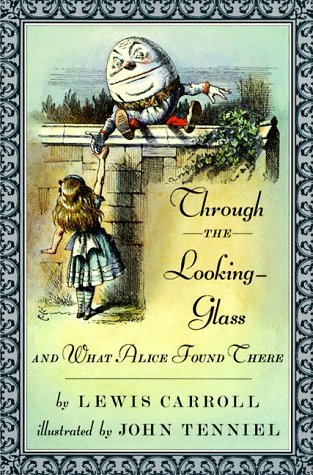
Through the Looking Glass and What Alice Found There by Lewis Carroll (Books of Wonder, c1871)
While the rabbit hole is also a great example of a portal, who hasn’t seen a mirror and imagined there was a world on the other side? Alice’s wild journey through the looking glass itself has captured the imagination in literature ever since with many mirrors acting as portals to elsewhere–often strange and dangerous elsewheres!
4.

Rules for Stealing Stars by Corey Ann Haydu (Katherine Tegen Books, 2015)
Priscilla and her three sisters have discovered that the closets in their home lead to fantastic places and things–secret sanctuaries from their increasingly uncertain life where they struggle to get through from day to day. But though these portals offer hope and magic to the sisters–it may not be the answer to solving their problems and bringing the family closer together.
5.

Milo Speck, Accidental Agent by Linda Urban (HMH Books for Young Readers, 2015)
In this humorous fantasy adventure, Milo goes to retrieve laundry from the dryer only to be snatched up and through a portal within the dryer! He finds himself in the world of Ogregon, where boys are a tasty snack for hungry ogres. Milo will have to use his wits to escape and find out how to put a stop to the whole operation!
6.

Time at the Top by Edward Ormondroyd (Purple House Press, c1963)
Susan is a girl growing up in 1960s New York City, utterly dissatisfied with life as she knows it. Then when she lends a mysterious woman a helping hand, she’s granted three magical journeys on an old elevator. The elevator takes Susan back in time , to 1881 where Susan finds life much more what she wishes it could be. But can she find a way to make it hers permanently?
7.

Coraline by Neil Gaiman (HarperCollins, c2002)
The 14th door in the rambling house where Coraline lives with her two distracted parents is indeed a magical gateway. But the world beyond it isn’t necessarily one it’s good to go explore. A twisted reflection of this world, what starts out being a marvelous adventure for Coraline soon turns dark indeed. Can she escape home again?
8.
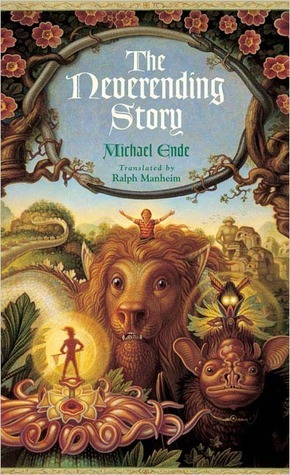
The Neverending Story by Michael Ende (Dutton Children’s Books, c1979)
The world over we know that books are portals into other worlds . . . but in the Neverending story the book truly is a portal. The book leads Bastian on an amazing adventure with Atreyu in a quest to stop the Nothing from swallowing the land of Fantastica. But it is Bastian who truly holds the key to saving their world, and to do so he must be brought into the story, through the book and into the world. From there he will venture on his own quest . . . but will he make it home again? This is a bit different from the movie version, so be prepared!
9.

The Secret of Platform 13 by Eva Ibbotson (Puffin, c1994)
We all know about the platform for wizards in the London subway that was popularized in Harry Potter, but there was an earlier one. Platform 13 at King’s Cross Station has a magical portal that opens once every 9 years for 9 days. Nine years ago the prince of a magical kingdom was kidnapped and taken through the portal as a babe into the human world. Now denizens of the magical realm prepare to cross through the portal and find their missing prince before the nine days are up!
10.

Howl’s Moving Castle by Diana Wynne Jones (Greenwillow Books, c1986)
In this case the portal is one created by the Wizard Howl. It’s attached to the door of his castle and is activated by turning a knob to different colors for different places. Most of those places are other places in the same world. But one leads to a version of Britain that seems to be close to our own, and appears to be the original world that Howl is from.
So there are my portals. Please share some of your own!
Flashback Fridays: Of all the forces in the universe, the hardest to overcome is the force of habit . . .
You’re just a kid who sometimes has strange things happen to them. But this latest bit is sort of wild–there are dead people in the cemetery talking to you. They aren’t creepy or dangerous, they’re just ordinary people, except, well, dead of course . . .
Do you remember:

Johnny and the Dead by Terry Pratchett (Corgi Childrens, c1993)
Johnny Maxwell is an odd kid whose family is going through troubling times. They live in a small town in the U.K. called Blackbury. There’s a cemetery in town, an old, mostly forgotten one that Johnny likes to wander by. But suddenly he sees dead people. And talks to them to. The dead in this cemetery aren’t frightening or anything–they’re just ordinary people who once lived in Blackbury. And they’re alarmed when they find out their cemetery is about to be destroyed in the name of progress and “Bright Futures.” They want Johnny and his friends to help.
And so begins a most unusual ghost story. Where ghosts teach the living about the power of history, memory and legacy and learn in turn that there’s more to life than death and cemeteries. And that sometimes it’s essential to break the rules. Sometimes habits are all that keep us pinned down.
Back in 1997 wandering around Oxford this was one of the very first Terry Pratchett books I encountered, and I still have a great deal of love and fondness for it. Johnny is pretty much every boy. He’s well-meaning, has some odd quirks and strange stuff happen to him, but he’s still pretty ordinary. He’s got his friends, and a family going through troubles that he’s trying to avoid. He’s not a chosen one or a secret heir. He’s just Johnny. But Johnny sees ghosts. His friends are disappointed they aren’t spooky zombies like you’d find in the Thriller video. But they get on board with helping him through yet another adventure. (Last time it was a video game that featured real aliens).
A lot of the residents of the cemetery are eager to talk to him and find out what’s gone on in the world since they died. All except for Mr. Grimm who constantly warns them about breaking the rules and doing things that are improper. Johnny slowly uncovers the history of the people buried in the cemetery–becoming more and more invested in their stories and what it means to Blackbury–the real Blackbury and not the gray town it’s becoming. He sees the real evil in this story:
Real dark forces… aren’t dark. They’re sort of gray, like Mr. Grimm. They take all the color out of life; they take a town like Blackbury and turn it into frightened streets and plastic signs and Bright New Futures and towers where no one wants to live and no one really does live. The dead seem more alive than us. And everyone becomes gray and turns into numbers and then, somewhere, someone starts to do arithmetic…”
It’s evil in the classic Sir Terry mode. The evil of negating humanity. The evil of treating people as things–that’s what Johnny is fighting. But while the kids are fighting to save the cemetery, the ghosts are realizing that the cemetery has grown too small for them. They are curious, they are wondering and interested and excited again. And so they finally break the rules and leave the boundaries of the cemetery. And they discover they were never meant to stay at all–that there is a beyond to explore and travel and continue in–and only fear and habit was holding them back. It’s something that reminds that every life has meaning, and that the past still matters, so long as it informs us in the present.
It’s a great book, and it inspired a TV miniseries in 1995. Sir Terry wrote two other books in the Johnny Maxwell Trilogy. The first was Only You Can Save Mankind (1992) and the third is J0hnny and the Bomb (1996) .
If you’ve never heard of Sir Terry Pratchett, I can only say I hope you will discover him. He is by far and away one of my favorite writers and has many titles for readers to discover. Some for children, and many more for adults. His quirky humor and dry observations are ultimately balanced by a sense of heart, profundity and poignancy that can turn a funny book into one that makes you tear up and cry–or realize why you’re alive.
Comments welcome!
 Views From the Tesseract